
Safety evidence for
clinical AI, before go-live
tapHospital is where clinical AI proves it is safe and sane with real clinicians and real failure testing before it ever touches a real hospital.
A production-grade simulated EHR ecosystem. Realistic clinical workflows. And longitudinal record layers no sandbox can provide. No IRB or BAA required.
Independent by design. We do not build, sell or distribute clinical AI. We take no revenue share. Our fee is the same whether a product passes or fails.
Why clinical AI needs neutral third party testing before go-live?
Regulatory expectations
Oversight demands evidence, not just policies
Regulators and accreditors are placing greater emphasis on documented performance, risk controls, and ongoing oversight. Testing helps show how a product behaves when clinical records are incomplete or workflows get complicated
Healthcare Due Diligence
Purchasing decisions need verifiable findings
Health systems need more than vendor-provided assurances. They need to know what was tested, what failed, what limitations remain, and whether the report they receive is authentic.
Evaluation by tapHospital
Find failures before they reach clinicians and patients
We stress-test clinical AI to find potential failures before go-live and reduce the risk of harm to clinicians or patients. We use blinded clinician review and provide independently verifiable safety evidence directly to authorized recipients. We have no financial stake in whether a product passes or fails.
Independent clinical review, verified evaluation reports, and electronic report delivery are part of evaluation by tapHospital only, not self-run readiness testing or dedicated R&D access.
Our clinical AI lab
MISSION
Enable safer scaling and deployment of clinical AI through independent testing and verifiable evidence.
VISION
Make independent safety evidence a standard part of clinical AI.
See our lab in action
WHO TESTS YOUR CLINICAL AI?
Independent physicians put your product through realistic patient cases, so safety claims rest on evidence rather than vendor testing.
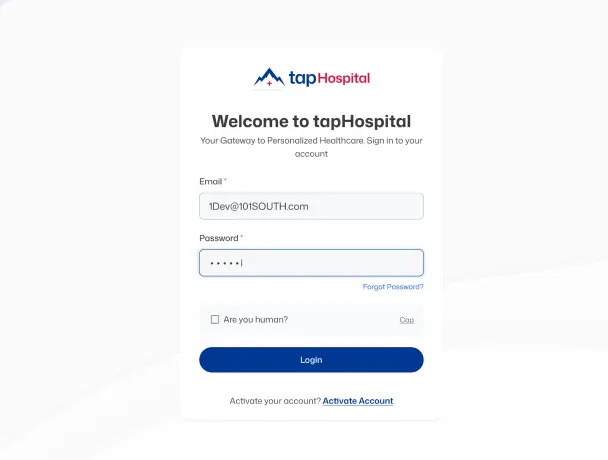
Branded Login
Your own EHR instance
Sign in to a tapHospital environment set up for your organization.
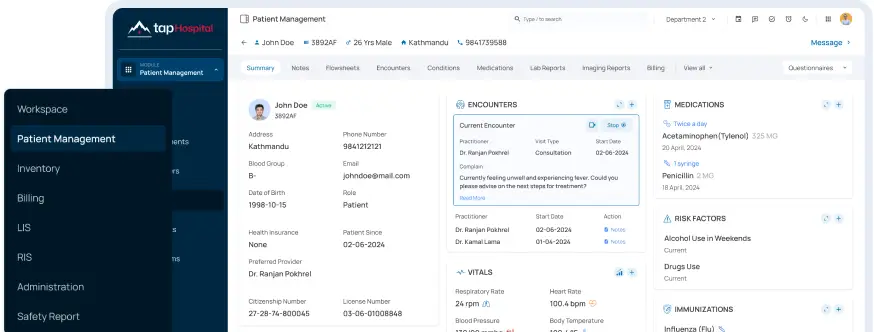
Synthetic Patients
The full EHR. Patient records, billing, lab, radiology, inventory and safety reporting in one place.
Teams and innovators moving clinical AI forward.
Whether you are preparing for a pilot, making a purchasing decision, or developing the next version, the right environment depends on your goal.
Clinical AI developers
Check integration readiness before a hospital pilot, investigate product limitations, and commission independent safety evidence for clinical stakeholders and buyers.
Healthcare deployers
Test vendor claims against relevant clinical workflows and patient populations before procurement or deployment, and reevaluate meaningful model or workflow changes
R&D Teams
Research & innovation teams
Build and iterate in an isolated synthetic hospital environment, with configurable workflows and realistic longitudinal patient journeys, without using real PHI.
Three separate environments for Three distinct deliverables.
Self-run tests, independent safety evaluations, and dedicated R&D access are separate engagements. Select only what you need.
01 · Explore & integrate
Self-Run Readiness Testing
$2,500
per integration
Connect your AI to Hospital's simulated EHR. Explore synthetic patient records, interact with editable workflows, and test product responses to failures.
Key Deliverables
Self-run integration and readiness findings
- SMART on FHIR, FHIR R4, and CDS Hooks integration, as applicable
- Access to simulated EHR modules, longitudinal synthetic records, and selected editable workflows
- Run self-tests and approved failure scenarios, inspect AI responses, and identify areas for improvement.
Important: Self-run Test does not include independent clinical AI evaluation, its evaluation cohorts, or a tapHospital-signed safety scorecard. That evaluation is commissioned separately.
Evaluation credit: 100% of the $2,500 fee can be credited to a qualifying independent evaluation contracted within 180 days after self-test findings are delivered.
02 · Independent evidence
Independent Clinical AI Evaluation
$15,000
per evaluation
Commission independent testing in controlled simulated clinical workflows, with failure scenarios, blinded clinician review, and clinical adjudication.
Key Deliverables
Independent, clinician-reviewed safety scorecard
- Five Domain evaluation: Clinical accuracy, Workflow integration, Human validation, Bias & Equity, and Privacy & Security.
- Independent safety scorecard and prioritized findings
- Neutral third-party evidence for healthcare buyers
- Online report authenticity verification and direct electronic report delivery by tap Hospital to authorized recipients
- Report disclosure and verification activity logs for product owners, with quarterly summaries
Revalidation: $7,500 for one additional evaluation of an updated model/version within the same scope, if contracted within 180 days of the initial evaluation. Subject to change-impact review.
03 · Continuous development
Dedicated R&D Environment
$50,000+
per year · custom scope
An isolated synthetic hospital workspace for ongoing clinical AI development, product integration, experiments, and workflow testing.
Key Deliverables
Dedicated, configurable synthetic hospital environment
- Configurable synthetic populations, scenarios, workflows, and integrations
- Continuous experimentation, iterations, and version testing
- Support for evolving product requirements and team training
Important: R&D access does not include independent clinical AI evaluation, its evaluation cohorts, blinded clinician review, or a tapHospital-signed safety scorecard. That evaluation is commissioned separately.
Custom Pricing: Annual scope and quote depend on configuration, integrations, usage, and support requirements.
All services use synthetic clinical data. Independent evaluation scope is defined by intended use, model/version, applicable workflows, patient population, and agreed testing protocol. Prices in USD, final terms governed by your agreement.
Document the product before you evaluate it.
A model card organizes your product's intended use, clinical context, target population, claimed benefits, and known limitations. It helps teams start a more specific conversation about testing.
Start a free draft here. You can review, edit, and download it without uploading clinical records. A model card is not a safety evaluation or certification.
Never upload or enter protected health information (PHI)/personally identifiable information (PII). You have an option to delete model card when no longer needed. We do not sell or market your data.
Model card disclosure. This free, optional drafting tool is informed by the Coalition for Health AI (CHAI) Applied Model Card and publicly available schema (© 2024 Coalition for Health AI, Inc.; source license). It produces a simplified draft, not a CHAI-validated, schema-compliant model card or an independent safety evaluation. Use of CHAI's materials does not imply CHAI endorsement. When you finish a card, its product details and answers are sent to and stored by tapHospital, so the card can be reopened from its link; anyone with that link can view it. tapHospital does not sell your entries. Do not enter patient information (PHI), credentials, or other confidential data.
Questions worth answering before you start.
No bundled promises or unclear labels. Each service has a defined scope and output.
An independent testing lab for clinical AI. Products run inside a production-grade simulated hospital, complete with EHR, radiology, lab, telehealth, and patient portal, populated entirely with synthetic patients. Licensed clinicians work blinded against your product in live scenarios. You leave with a safety scorecard across five domains, before the product ever touches a real patient.
Three groups: clinical AI developers, healthcare deployers and research and development teams; developers who need independent, reproducible evidence of clinical safety before a first hospital pilot. And health systems and academic groups who need neutral third-party validation of a vendor’s claims, for procurement due diligence and for readiness against Joint Commission RUAIH and URAC.
Sandboxes tell you whether your code runs. We tell you whether a clinician trusts the output, and exactly where it breaks. We use Synthea ourselves to generate the patient population. The difference is what sits on top of it: a longitudinal EHR, an adversarial failure layer, and blinded clinical review. Complementary, not competing.
No. tapHospital performs testing and validation. We report what we found, how we found it, and what it means, in a scorecard and a written explanation across five domains. We do not issue a seal of approval and we are not a certification body. The distinction matters. A certification asks you to trust the issuer. Our report lets you inspect the method and the evidence yourself, and tells you which scenarios broke the product, so you can act on it.
Worth stating plainly, our testing is not a step outside the accreditation path. It is the evidence that path runs on. Certification schemes and hospital AI governance committees increasingly ask for independent testing performed by someone other than the vendor and buyer, and that is exactly what a tapHospital engagement produces.